Germany has begun receiving its first-ever liquefied natural gas deliveries from Oman, even as war in the Middle East chokes global supply routes — but a deeper look at the country's gas supply chain suggests Berlin may be more exposed to the crisis than official figures let on.
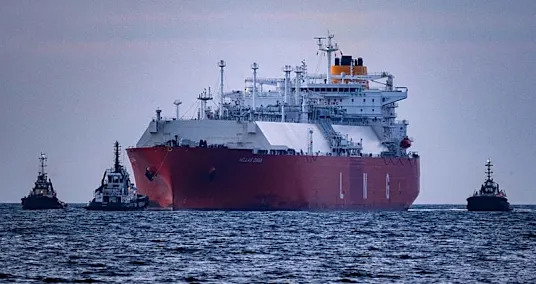
The shipments, delivered under a four-year contract signed in 2023 between Oman's state LNG producer and German gas importer Securing Energy for Europe (SEFE), began as planned this month, a SEFE spokesperson told the German Capital magazine.
Oman sits on the far side of the Strait of Hormuz from Iran, and the company said deliveries are unaffected by the ongoing conflict.
The news offers a rare bright spot in an otherwise tightening energy picture.
Iran's blockade of the strait has halted all LNG exports from Qatar, the world's second-largest LNG exporter, while an Iranian strike on Qatar's Ras Laffan production facilities in mid-March knocked out 17% of the Gulf state's output capacity.
QatarEnergy chief executive Saad al-Kaabi said repairs will take three to five years.
The company has since invoked force majeure on several long-term contracts, with customers in China, South Korea, Italy, and Belgium among those affected.
Economics Minister Katherina Reiche has sought to play down the risks, saying Germany receives "no significant quantities" of LNG from the Gulf and that 90% of its gas arrives via pipeline from Norway, the Netherlands, and Belgium.
Germany more exposed than expected?
Those figures are technically accurate — but they obscure a more complex picture, according to Capital.
Only 10.3% of Germany's gas imports arrived via its own four LNG terminals last year, all of it almost entirely from the US.
However, the Netherlands and Belgium, which together supplied 45% of Germany's total gas imports in 2025, are themselves among the EU's largest LNG importers.
Rotterdam and Zeebrugge receive large volumes of liquefied gas by tanker, regasify it, and pipe it onward into Germany.
Belgium's Zeebrugge terminal handled a record 55.5 terawatt-hours of LNG in 2025, double its previous record.
The Netherlands sourced 45% of its total gas imports as LNG in 2024, with American cargoes accounting for 30% alone, Capital reports.
Because the origin of individual gas molecules moving through pipelines cannot be traced, the true scale of Germany's indirect LNG dependency — and its indirect exposure to US supply — is impossible to pin down precisely. But the direction of travel is clear.
Germany's storage levels add to the pressure. Reserves currently stand at around 22%, historically low for this point in the year, according to Capital.
latest_posts
- 1
 Gartex Texprocess India to showcase innovations across textile ecosystem
 - 2Satellite data reveals a huge solar storm in 2024 shrank Earth's protective plasma shield
- 3French high-speed train slams into truck, killing TGV driver
- 4Israel strikes Beirut amid rocket fire from Hezbollah and Iran
- 5Instructions to Pick the Ideal Pre-assembled Home for Your Necessities




- OPEC’s No. 2 Producer Burns Its Own Gas—Then Buys Iran’s
- Interstellar comet 3I/ATLAS' journey through our solar system, in photos
- The most effective method to Apply Antiquated Ways of thinking in Current Brain science Practices
- Santa's sleigh or the International Space Station? How to spot a bright Christmas flyby Dec. 24 and 25
- AbbVie plans to build out its presence in obesity market
- RFK Jr. wants to scrutinize the vaccine schedule – but its safety record is already decades long
- Volkswagen Just Built a Plug-In Tiguan for China That America Doesn’t Get
- The Ascent of Robots: Occupations That Man-made brainpower Might Dispense with
- Dad issues urgent plea to find stem cell donor for his son